Rising energy prices, pressure for energy self-sufficiency in companies, and available subsidy programs are leading to record interest in photovoltaic power plants on industrial, warehouse, and production halls in 2026. Investments in photovoltaics today not only bring companies savings on electricity costs, but also higher competitiveness and protection against future energy price increases.
When planning photovoltaics, it is important not to focus only on the power output of the plant itself. The load-bearing capacity of the roof structure, the orientation of the hall, energy storage options, and available subsidy programs all play a crucial role. The combination of a well-designed prefabricated hall and a properly dimensioned PV system can significantly affect the economics of the entire project.
Structural Assessment: The Basis of Every Photovoltaic System on a Hall
Many investors believe that a new hall automatically meets the conditions for installing photovoltaic panels. In reality, it is necessary to verify whether the roof structure can safely bear all loads during operation. The photovoltaic system represents an additional load of approximately 15 to 25 kg/m². On top of that, wind, snow, and other operational loads must be considered. Therefore, a structural assessment is essential not only for older buildings but often also for new constructions.
The ideal situation occurs when the investor is aware of future photovoltaics already at the project preparation stage. The hall structure can then be designed from the outset to easily support the future PV installation. This avoids additional modifications or costly reinforcement of the structure.
Hall Orientation and Roof Pitch
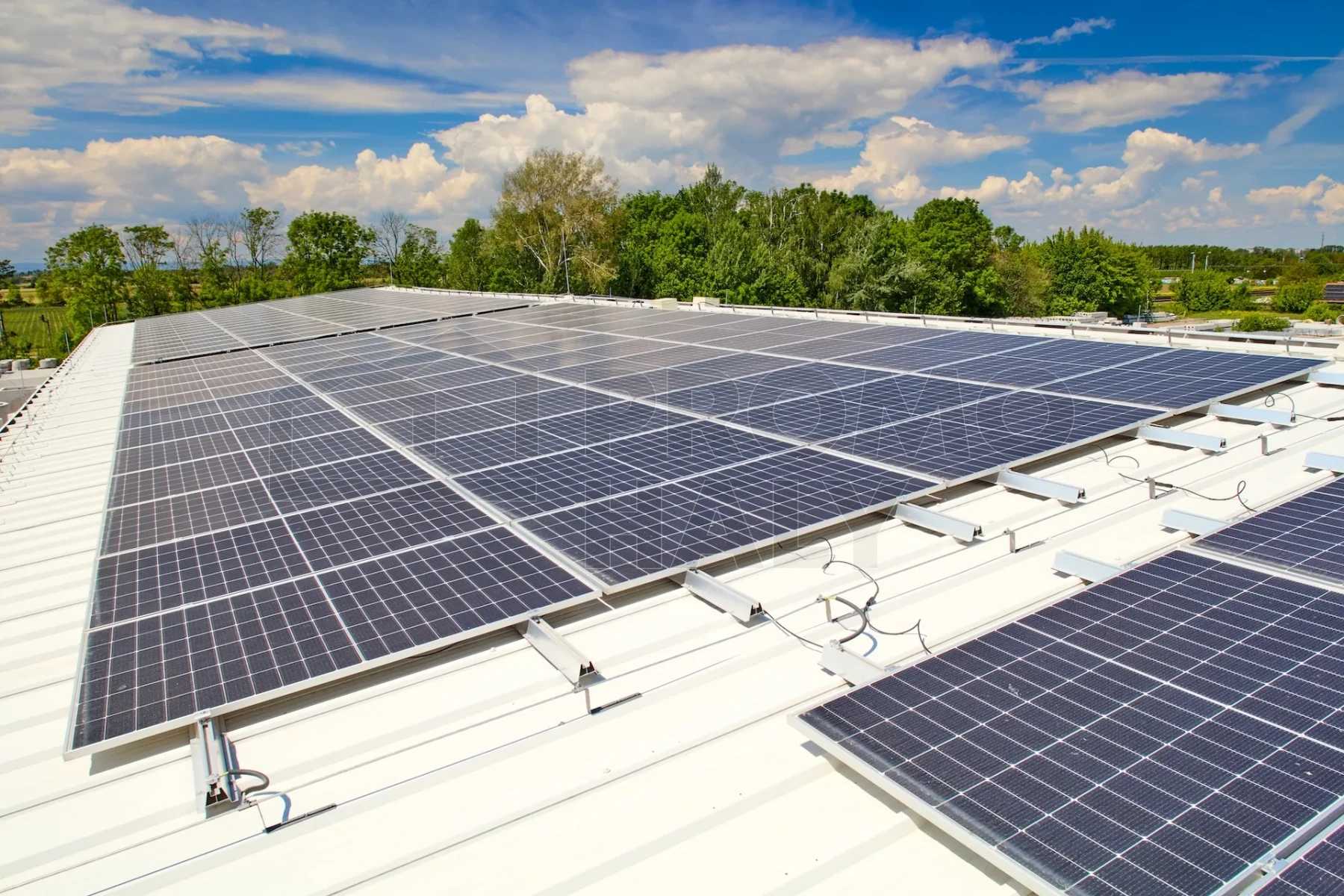
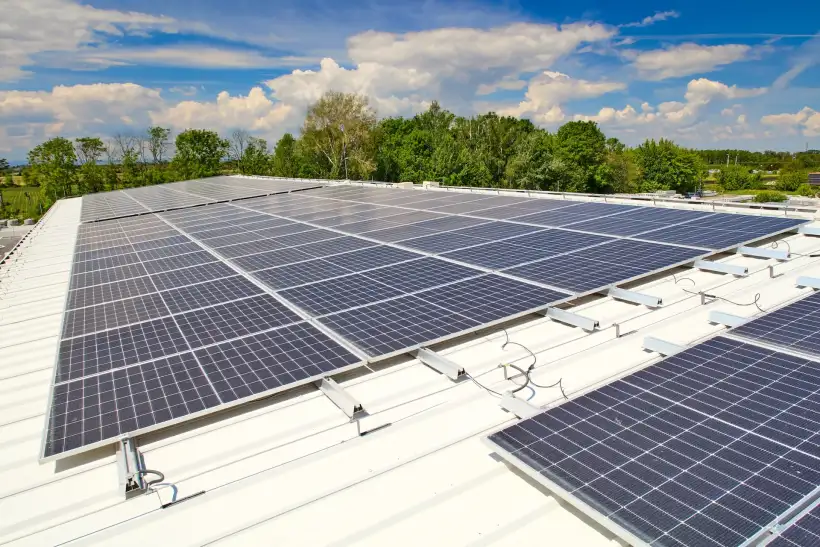
Flat roofs, which are typical for most industrial halls, allow panels to be placed in the optimal direction using supporting structures. This gives the investor greater flexibility in hall design and the ability to efficiently use large roof areas.
How Much Electricity Does Photovoltaics on a Hall Produce?
In the conditions of the Czech Republic, you can roughly expect annual production of about 950 to 1,100 kWh for each installed 1 kWp of capacity.
Production and warehouse halls also have the advantage of high own consumption during the day. Electricity is consumed directly during production, which significantly improves the project’s economics compared to households, where surplus energy is often fed into the distribution grid.
Comparison of Output, Investment, and Payback
| Parameter | PV 100 kWp | PV 250 kWp | PV 500 kWp |
|---|---|---|---|
| Required roof area | approx. 500-600 m² | approx. 1,250-1,500 m² | approx. 2,500-3,000 m² |
| Annual electricity production | approx. 100 MWh | approx. 250 MWh | approx. 500 MWh |
| Indicative investment | 2.5-3.5 mil. CZK | 5-8 mil. CZK | 10-15 mil. CZK |
| Annual energy savings* | 450-650 thousand CZK | 1.1-1.6 mil. CZK | 2.2-3.2 mil. CZK |
| Payback without subsidy | 5-8 years | 4-7 years | 4-6 years |
| Payback with subsidy | 3-6 years | 3-5 years | 3-5 years |
| Typical use | smaller production, service | production hall, warehouse | logistics center, industrial complex |
*The model calculation is based on high own consumption of produced electricity during the day.
The comparison shows that the most commonly installed solution is around 250 kWp, which offers a very good ratio between investment costs, usable production, and payback. However, in larger manufacturing companies and logistics centers, installations of 500 kWp and more are increasingly common.
Subsidies for Photovoltaics for Companies in 2026
A significant factor influencing the project’s economics is subsidy programs. In 2026, companies most often use support from the Modernization Fund, the National Recovery Plan (NPO), and the OP TAK program. These programs focus on supporting renewable energy sources, storage, energy savings, and reducing the emission intensity of companies. However, the conditions of individual calls change over time, so it is advisable to check the current financing options and application deadlines before starting the project.
Energy Storage and Battery Systems
The current trend is not only electricity production but also its efficient use. That’s why more and more companies are supplementing photovoltaic power plants with battery storage. Storage allows surplus energy to be stored and used during periods of lower production or higher consumption. This enables the company to increase its own electricity consumption, limit feed-in to the distribution grid, and at the same time reduce energy purchase costs during peak periods. Battery storage is most beneficial especially where there are significant consumption fluctuations or where part of the operation runs outside the main production hours of the photovoltaic power plant.
Virtual Batteries and Energy Sharing
Thanks to new energy legislation, companies are gaining new options for using the electricity they produce. Energy sharing between multiple consumption points or within energy communities is becoming increasingly important.
Operators of multiple halls, production complexes, or logistics centers can thus distribute the produced electricity more efficiently between individual buildings and maximize the use of energy produced on their own roofs.
It’s Best to Address Photovoltaics Already at the Hall Design Stage
When constructing a new prefabricated hall, it pays to consider the future installation of photovoltaics already during project preparation. The designer can adapt the load-bearing capacity of the structure, design a suitable roof envelope, prepare cable routing, or future space for inverters and battery systems. Such an approach reduces future investment costs and provides a technically cleaner solution than later modifications to an already completed building.
Conclusion
Photovoltaics on the roof of a prefabricated hall is among the most attractive investments for reducing operating costs in 2026. A properly designed PV system can significantly reduce dependence on electricity supply from the grid, increase the company’s energy self-sufficiency, and at the same time improve operational economics.
The best results are achieved by projects where photovoltaics are considered already at the hall design stage. The investor thus gets a structure prepared for future energy requirements without the need for additional interventions and operational restrictions.
Q&A
Can every prefabricated hall support photovoltaics?
No. Every hall should undergo a structural assessment because photovoltaic panels represent an additional load on the structure, and the effects of snow, wind, and other operational factors must also be considered.
Is it advisable to consider photovoltaics already when designing a new hall?
Yes. If the future installation of a PV system is considered already in the project phase, the hall structure can be designed for the required loads and costly later modifications can be avoided.
How large a roof do I need for a 100 kWp power plant?
For a 100 kWp installation, you typically need about 500 to 600 m² of usable roof area. The exact value depends on the type of panels, roof orientation, and the layout of individual modules.
Is photovoltaics worthwhile even without a subsidy?
In most production and warehouse operations, yes, because companies can consume a significant portion of the electricity produced directly during its generation, which increases the economic efficiency of the investment.
What is the lifespan of a photovoltaic power plant?
Modern photovoltaic panels typically last 25 to 30 years. Inverters are usually expected to be replaced after 10 to 15 years of operation, depending on usage and operating conditions.
Is a battery storage system worthwhile?
Yes. A battery system allows you to store surplus energy produced and use it later, thus increasing your own electricity consumption and reducing dependence on the distribution grid.
Is it possible to share electricity between multiple buildings?
Yes. New rules allow sharing of produced electricity between multiple consumption points and within energy communities, which is especially appreciated by companies with multiple operations or halls.
What do investors most often forget?
The most common mistakes are underestimating the structural assessment, connection capacity to the distribution network, fire safety solutions, and future expansion of the photovoltaic power plant or battery storage.
_kopie.webp)


