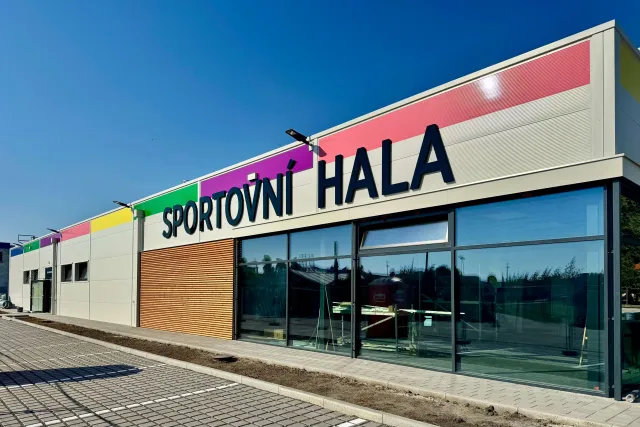
Sports halls
Sports halls are always designed as single-storey buildings, with an emphasis on space and potential visitors to these facilities. The most common variant of this type of hall is a tennis hall or gyms for multi-purpose sports (floorball, basketball, or badminton, squash). Recently, there has also been investment in sports halls with ice rinks intended for figure skating, curling, speed skating, and especially ice hockey, which is very popular among the general public in the Czech Republic.
Main advantages of prefabricated sports halls
- Speed of construction and the associated price compared to traditional masonry buildings
- Possibility of interesting architectural solutions
- High variability in cladding – both in color and in the choice of materials or their combinations
- Excellent thermal properties of buildings with low operating costs
- Easy maintenance
- Low costs for building foundations compared to traditional constructions
Construction of a prefabricated sports hall
The structure of prefabricated sports halls is again designed with an emphasis on minimizing columns and maximizing usable space in these halls. The structure usually has a fire resistance of 15 minutes and is adapted to functionality. The roof slope and type of structure depend on the type of sport and the required heights for the given sport. Tennis sports halls have the greatest slope due to the requirements at the eaves and ridge, where the height difference is usually 6–11 m. Badminton requires 7 m across the entire area, table tennis has completely different requirements, etc. For other types of purpose-built halls, the design is based on architectural requirements. For large spans, it is possible to use arched truss structures, or for smaller halls of 20 x 40 m, the economics of the building often lead to the use of frame structures with a gable roof. During construction, requirements for stands or facilities are often addressed. Some gyms are a combination of concrete columns and steel truss structures.
Insulation of sports halls
Cladding of sports halls is designed with an emphasis on the thermal properties of the envelopes in order to minimize heating costs for often large spaces, while for ice rinks the opposite effect is desired, so that the hall does not overheat in warmer periods and cooling costs do not increase. Classic sandwich panels on the walls are often used, and often on the roofs as well; for larger spans over 40 m, built-up roofs with foil are used.
Glazing and lighting
Glazing in sports halls is not a priority, as bright light often interferes with sporting events, so most halls use purely LED lighting. Daylight is only a supplement for maintenance and orientation in these halls. Roof skylights are not used. If large glazed walls are designed for architectural reasons, they are supplemented with shading elements such as blinds or awnings. However, emphasis is placed on emergency exits, especially in halls where more visitors to sporting events may be present. All doors are emergency exits with panic bars for fire safety reasons.
Layout of the sports hall
Halls are divided into facilities – changing rooms with showers and toilets. The reception is often combined with a bar and refreshments. Some better-equipped sports facilities also include a restaurant or even accommodation. Another addition is stands or balconies overlooking the main area, which is the playing field.
Surfaces of sports halls
Each sport requires its own specific surface. The most common surfaces in halls for so-called outdoor activities are:
- Artificial polyurethane surfaces – For example, Conica Conipur is among the top in its field, suitable for multi-purpose halls, gyms, tennis and gymnastics halls. They have high durability, are seamless and easy to maintain, are moisture resistant, and last but not least, offer a wide range of colors.
- Carpeted indoor surfaces – With a compact and effective cushioning layer, these are also among the universal surfaces for halls and gyms. They are medium-fast surfaces and are suitable not only for recreational players but also for competitive players. They have high durability, easy surface repair, carpet moisture resistance, and a favorable price.
- Wooden surfaces are another alternative for floors in sports halls. A great advantage is often the springiness of the floors. These types of floors are often used in professional sports. The advantage is thus the springiness, either floating or anchored. The floor can often be dismantled. This type is widely used in multi-purpose halls where, for example, an ice rink alternates with a classic wooden floor.
- There is an abundance of other surfaces – acrylic, artificial grass, special cushioning surfaces for fitness and gyms, textile floors, linoleum, or cork. These are handled by specialized companies that sell purely sports flooring for halls.
Price of a sports hall
The price of a sports hall is mainly influenced by the investor's requirements. You can find a detailed price of the hall according to the visualization in the price list of halls. You can also use our configurator.
If you are interested in sports halls, you can contact us at +420 728 305 164, by email at poptavky@promohaly.cz, or use our inquiry form or the configurator.
Photo Gallery
submit a non-binding inquiryConfigure the hall