Materials of prefabricated halls
Construction
Steel Structure

Steel structures are used in an ever-wider range of industries and for an increasing variety of products. They can be of the frame, truss, or arched type.
A typical feature of steel structures is their low weight and adaptability. Other undeniable advantages of steel structures include their fast assembly, long lifespan, a vast number of functional as well as aesthetic solutions, easy combination with different types of materials, their strength, stability, and, increasingly emphasized today, their recyclability in terms of environmental impact. Last but not least, we must not forget the economic aspect of steel structures and the possibility of high fire resistance.
Find out moreConcrete Structure

Reinforced concrete structures can be used for all types of halls. They feature the typical concrete surface and their structure contains only natural materials. The main advantages include their high fire resistance, even without any further modifications, suitability for large-scale halls and buildings, as well as for multi-story halls. Other benefits are their long lifespan, high load-bearing capacity, and consequently high compressive strength of the structure.
Coatings for Structures

Coatings for industrial halls are gaining increasing attention today, thanks to their quality and high durability, providing the structure with long-term protection. An important criterion for choosing the right coating system is the substrate – that is, the surface of the material to be coated. Another factor is the application method – whether the paint can be applied manually (with a roller or brush) or if it is necessary to use high-pressure spray equipment. Of course, drying time also plays a major role. This depends on the temperature and humidity of the area designated for applying the protective coating. The corrosive environment and the required lifespan are also important factors in choosing the right coating material.
Find out moreCladding with Panels

Sandwich panels are among the current trends in building elements. Only high-quality materials are used in their production, and for prefabricated halls, they can be used for both wall and roof cladding. The specific type of sandwich panel is designed to correspond with the climatic and all other influences present at the location of the prefabricated hall, and of course, to meet the aesthetic requirements and demands of the customer.
Sandwich panels offer a wide range of advantages. They boast excellent fire resistance and thermal insulation properties, as well as quick installation, long lifespan, and easy maintenance and appearance.
The composition of a sandwich panel consists of two external galvanized sheets and an internal core of the required thickness.
Find out moreFlat Built-up Roofs with Membrane

Built-up roofs with membrane are a modern feature used on prefabricated halls. Built-up roofs on prefabricated halls are used in several different compositions, with the decisive factors being fire resistance, appearance (parapets), use of the hall, and also the roof pitch.
Prefabricated halls with a low pitch and parapet on the cladding have this as the only alternative to sandwich panels or uninsulated roofs where the pitch is less than 4°. Built-up roofs, especially in combination with mineral wool (Combi ROOF), have excellent fire resistance and outstanding thermal insulation properties, as well as quick installation, long lifespan, and easy maintenance.
The composition of a built-up roof with membrane has many alternatives and is described separately,
Find out moreCladding with Sheet Metal
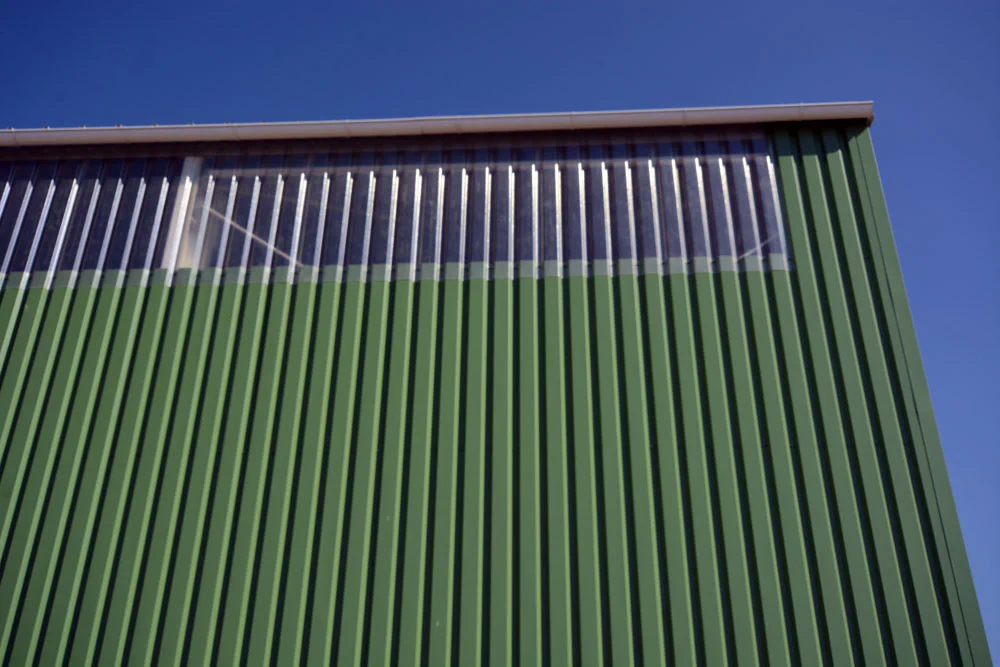
The basis of trapezoidal sheets is a steel sheet that is hot-dip coated with a layer of zinc or aluzinc. Just like sandwich panels, trapezoidal sheets can also be provided with a colored layer that serves a protective function and is chosen depending on the influence of the surrounding environment. There is a wide range of both colors and types of surface modifications, allowing for various design combinations according to the customer's wishes, for facades and roofs as well as for interior spaces.
The main advantages of trapezoidal sheets include their low weight, yet they are still a highly durable and massive material, which brings the benefit of resistance and strength in bending. Another advantage is their easy installation, transport, and handling; they are non-combustible, frost-resistant, and do not absorb any water.
Doors

Doors are among the most heavily used infills of a prefabricated hall, so it is important to pay them increased attention. For prefabricated halls, plastic doors are most commonly used. As with windows, these feature a quality plastic frame with a special reinforcement that ensures maximum strength of the door leaf. Together with the arrangement of the space between the glass panes, they guarantee excellent thermal and sound insulation. The hardware ensures easy handling of the doors, can have increased load capacity, and several levels of security, thus protecting against forced entry.
All doors are manufactured according to customer requirements and, like windows, can be not only plastic but also aluminum.
Windows and Glazed Facades

Windows and glazed facades play an important role in ventilation and lighting of the entire prefabricated hall. Moreover, their correct selection can have a significant impact on the safety of the hall and its thermal protection. Windows, and especially glazed facades, contribute to the overall design of the hall – giving buildings an original, modern, and architecturally interesting appearance.
For prefabricated halls, plastic windows are most commonly used. They reduce both lighting costs and, thanks to suitable color adaptation, create a significant aesthetic component of the hall. This type of window can be supplied in any width and height, and there is also a wide range of colors, in RAL shades or wood imitation. Of course, it is possible to have different colors for the interior and exterior, allowing the windows to match the overall design of the hall.
Gates

For the needs of prefabricated halls, industrial sectional gates are most commonly used, always manufactured according to the client's requirements and tailored to the specific building. This type of gate requires minimal space, thanks to the opening system upwards, which means there are no restrictions behind or in front of the gate. Industrial sectional gates can be operated manually or electronically. In both cases, they meet safety requirements in all phases of opening, while automatic industrial sectional gates also ensure easy handling thanks to the electric drive. Gates are mainly used in storage halls and vehicle service centers.
Skylights and Daylighting

The main purpose of skylights is to illuminate the space under the roof, offering an excellent solution for lighting a prefabricated hall at attractive prices. This type of lighting is much more efficient than any artificial lighting and is also healthier for people. Skylights also partially contribute to the ventilation of the hall. Today, there are many types of skylights, such as arched, strip, point, saddle, monopitch, dome, and others. The dominant material is polycarbonate, which has much better thermal insulation properties than the previously used wired glass.
Polycarbonate daylighting panels can be used for both roof and perimeter cladding, but are not suitable for environments with high humidity or, conversely, where there is a high internal temperature.
Metalwork Elements

Our company also supplies and installs various types of metalwork elements. The most common include operational or fire ladders, railings, lintels for gates, windows or doors, staircases, as well as the manufacture of machine or equipment structures.